~20%of resting energy is used by the brain, about 2% of body weight[1]
Sleephelps consolidate newly learned information, according to a major review[2]
~2%larger hippocampus after a year of walking in one trial with older adults[3]
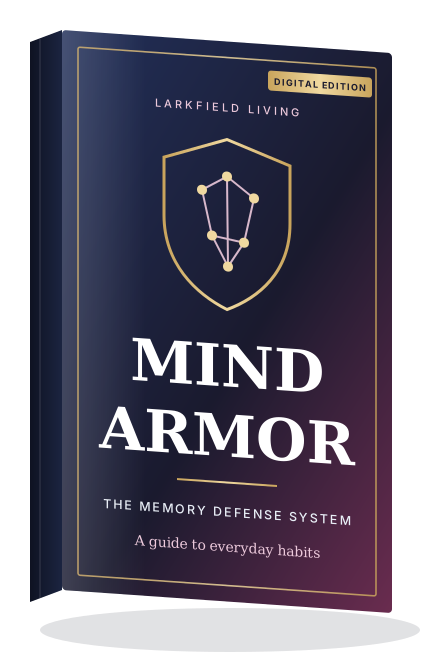
These studies were conducted independently and did not evaluate Mind Armor: The Memory Defense System. They are cited to support the general information on this page. Individual results vary.
Inside the guide: four parts
Each part of the guide covers one theme. Under each one below you will find a short note on what published research has examined in that area.
01
Food and nutrients
Eating patterns and nutrients that scientists have explored in relation to memory.
Research note: DHA, an omega-3 fat in fatty fish, is a structural component of brain cell membranes.
[4] B vitamins help produce neurotransmitters.
[5] Older adults eating about one daily serving of leafy greens showed a slower pace of age-related change on memory and thinking tests.
[6] In a small pilot, daily wild blueberry juice was followed by better scores on some memory tasks.
[7]
02
Everyday rhythm
Movement, sitting time and sleep routines that have been studied in relation to focus.
Research note: Two-minute walking breaks every 30 minutes offset the drop in brain blood flow seen during four hours of continuous sitting in a laboratory study.
[8] Sleep experts recommend seven or more hours per night for adults.
[9]
03
Staying engaged
Learning, hobbies and social connection as part of an active lifestyle.
Research note: Older adults who spent about three months learning demanding skills showed gains in episodic memory.
[10] A systematic review associated social activities and networks with better results on tests of thinking skills.
[11]
04
Long-term well-being
Broader wellness practices that adults often read about as they get older.
Research note: A review of 47 trials reported small improvements in some measures of psychological distress with mindfulness meditation programs.
[12] A “Western” eating pattern was associated with a smaller hippocampus in adults in their sixties.
[13]
Before you decide: what this is, and what it is not
It is- A digital educational guide
- A plain-language look at nutrition, routine and engagement topics
- Something to read at your own pace
- Offered as guide access or guide + video lessons
- A way to prepare questions for your healthcare provider
It is not- A supplement, a medication or a medical device
- Medical advice or a replacement for your doctor
- A treatment for any disease or condition
- A promise of any specific result
Choose your format
Both formats are digital and charged once, with no subscription.
Guide Access
$147
one-time · USD
- The complete digital guide
- All four parts
- Read on computer, tablet or phone
Select Guide AccessGuide + Video Lessons
$250
one-time · USD
- Everything in Guide Access
- Video lessons for each of the four parts
- Watch at your own pace
Select Guide + Video Lessons
Common questions
How is it delivered? Access instructions are sent to the email address you enter at checkout. Nothing is shipped.
Is there a subscription? No. Each format is a single payment.
What if it is not for me? Email [email protected] from the address used at checkout to request a refund, as described in our Terms of Use.
Mind Armor: The Memory Defense System is for informational and educational purposes only. It is not intended to diagnose, treat, cure, or prevent any disease. Individual experiences vary.
Scientific references
The statements on this page are supported by the peer-reviewed studies below, which were conducted independently and did not evaluate Mind Armor: The Memory Defense System.
- Raichle ME, Gusnard DA. Appraising the brain's energy budget. Proc Natl Acad Sci USA. 2002;99(16):10237-10239. pubmed.ncbi.nlm.nih.gov/12149485/
- Rasch B, Born J. About sleep's role in memory. Physiol Rev. 2013;93(2):681-766. pubmed.ncbi.nlm.nih.gov/23589831/
- Erickson KI, et al. Exercise training increases size of hippocampus and improves memory. Proc Natl Acad Sci USA. 2011;108(7):3017-3022. pubmed.ncbi.nlm.nih.gov/21282661/
- Gómez-Pinilla F. Brain foods: the effects of nutrients on brain function. Nat Rev Neurosci. 2008;9(7):568-578. pubmed.ncbi.nlm.nih.gov/18568016/
- Kennedy DO. B vitamins and the brain: mechanisms, dose and efficacy — a review. Nutrients. 2016;8(2):68. pubmed.ncbi.nlm.nih.gov/26828517/
- Morris MC, et al. Nutrients and bioactives in green leafy vegetables and cognitive decline: prospective study. Neurology. 2018;90(3):e214-e222. pubmed.ncbi.nlm.nih.gov/29263222/
- Krikorian R, et al. Blueberry supplementation improves memory in older adults. J Agric Food Chem. 2010;58(7):3996-4000. pubmed.ncbi.nlm.nih.gov/20047325/
- Carter SE, et al. Regular walking breaks prevent the decline in cerebral blood flow associated with prolonged sitting. J Appl Physiol. 2018;125(3):790-798. pubmed.ncbi.nlm.nih.gov/29878870/
- Watson NF, et al. Recommended amount of sleep for a healthy adult: a joint consensus statement of the American Academy of Sleep Medicine and Sleep Research Society. Sleep. 2015;38(6):843-844. pubmed.ncbi.nlm.nih.gov/26039963/
- Park DC, et al. The impact of sustained engagement on cognitive function in older adults: the Synapse Project. Psychol Sci. 2014;25(1):103-112. pubmed.ncbi.nlm.nih.gov/24214244/
- Kelly ME, et al. The impact of social activities, social networks, social support and social relationships on the cognitive functioning of healthy older adults: a systematic review. Syst Rev. 2017;6(1):259. pubmed.ncbi.nlm.nih.gov/29258596/
- Goyal M, et al. Meditation programs for psychological stress and well-being: a systematic review and meta-analysis. JAMA Intern Med. 2014;174(3):357-368. pubmed.ncbi.nlm.nih.gov/24395196/
- Jacka FN, et al. Western diet is associated with a smaller hippocampus: a longitudinal investigation. BMC Med. 2015;13:215. pubmed.ncbi.nlm.nih.gov/26349802/
Advertising Disclosure: This page is an advertisement for a digital educational product sold by Silverstone Media Group LLC.
Medical Disclaimer: The content of this page and of Mind Armor: The Memory Defense System is for general educational purposes only and is not medical advice. Always consult a qualified healthcare professional regarding medical concerns.
FDA Disclaimer: These statements have not been evaluated by the U.S. Food and Drug Administration. This product is not intended to diagnose, treat, cure, or prevent any disease.
Results Disclaimer: Individual experiences vary and no specific outcome is guaranteed.